


Earn steady returns with low-risk Fixed Income and Bonds
Diversify your Portfolio Today


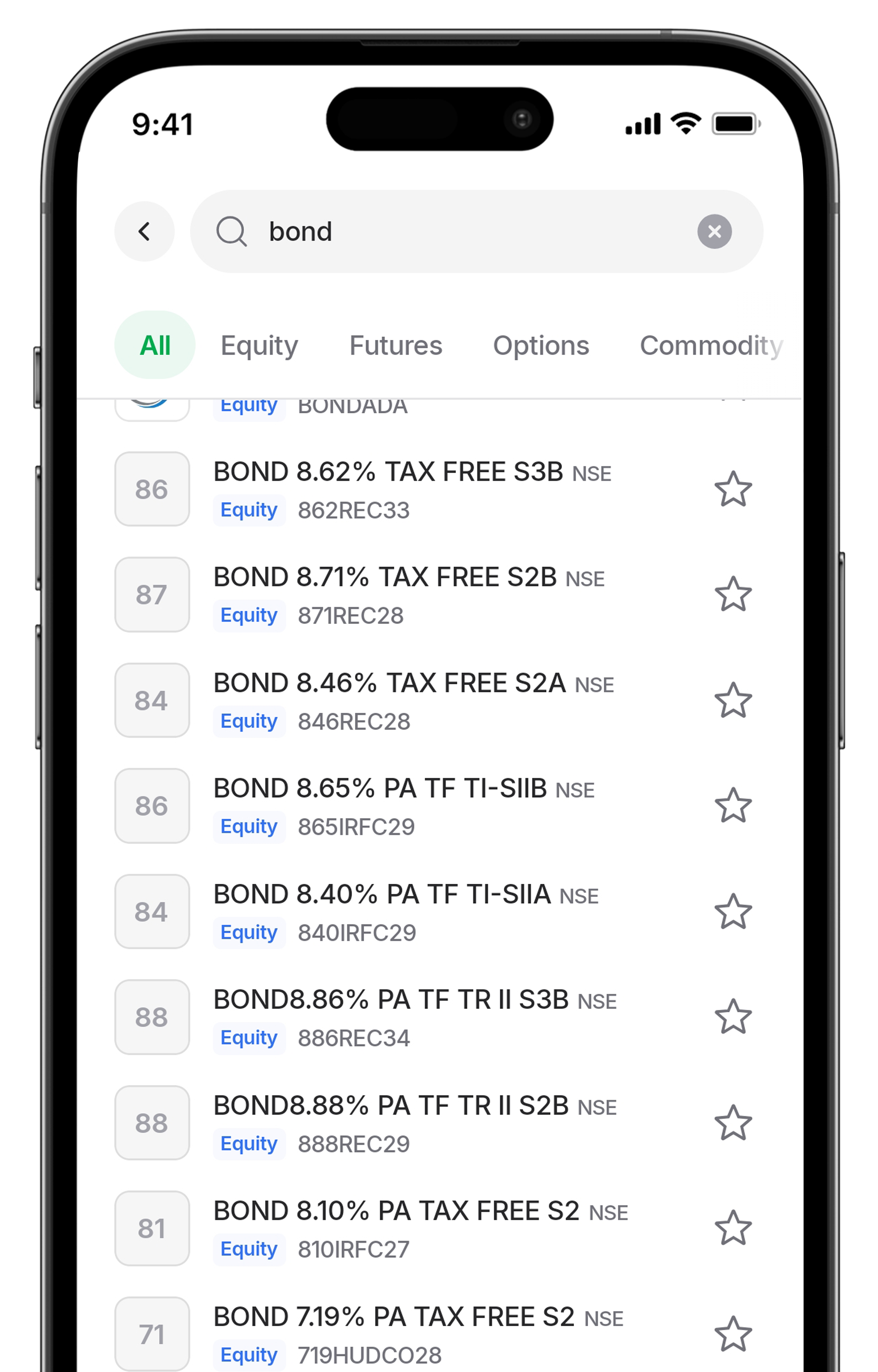

What is a Bond?
A bond is a debt security issued by corporations, governments, or other entities to raise capital. When you buy a bond, you're lending money to the issuer in exchange for regular interest payments and the return of the face value on maturity.
The bond agreement between the issuer and the investor comes with the details of interest rate, terms of payment (debt servicing), maturity etc., and are listed with a face value (principal) that is repaid at the time of maturity. The interest rate of bonds is called the coupon rate, and the interest payouts are predefined as per the agreement. Bonds are traded in the secondary markets and can be bought and sold like other investment instruments.
Why Invest in Bonds?

Provides stable income through fixed interest (coupon) payments.
Ideal for capital preservation and low risk investing.
Helps in diversifying portfolios away from equities.
Offers predictable returns, suitable for retirement planning and conservative investors.
Benefits of Fixed Income & Bonds
Steady Returns
Regular income through fixed interest.
Capital Safety
Lower volatility compared to equities.
Diversification
Balances high-risk assets in a portfolio.
Predictable Cash Flows
Useful for financial planning.
Tax Efficiency
Some bonds offer tax-free interest (e.g., municipal bonds).
Types of Bonds

How to Start Investing in Bonds Step-by-Step

Open a Demat & Trading Account
Complete KYC Verification online, upload your documents online.
Browse Available Bonds via the bond section.
Evaluate Bond Details – issuer, credit rating, maturity, and yield.
Place Your Order through the online portal.
Hold in Demat Account and receive interest as per schedule.
Track & manage your bond investments via your dashboard.
What are Bonds and Debentures?
Are debt instruments backed by collateral or issued by the government.
Are a type of bond, usually unsecured, and rely on the creditworthiness of the issuer.
Both offer interest payments and repay the principal at maturity but differ in risk and security features.
What are Features of Bonds?

How Does a Bond Work?
While governments and private organizations can raise funds through disinvestment or public offerings like IPOs, such methods do not guarantee a consistent flow of capital. To secure more stable funding, they often issue bonds.
Bonds function like other debt instruments, requiring the issuer to make regular interest payments—known as coupons—to the bondholders, along with repaying the principal amount at maturity. Upon issuing the bond, the issuer agrees to pay interest at a predetermined rate for the duration of the bond's term.
After issuance, bonds can be traded in the secondary market. Investors may choose to hold them until maturity to receive all scheduled interest payments or sell them to others, potentially earning a profit if the bond's market price exceeds its face value. When a bond is sold to a new investor, the issuer continues making interest payments—but these payments are directed to the new bondholder as per the terms of the original issuance.
How to Invest in Bonds?
Via Stockbrokers (online trading platforms).
RBI Retail Direct for government bonds.
Mutual Funds / Bond ETFs.
Offers Through private placements or NCD IPOs.
What Factors Should You Consider Before
Investing in Bonds?
Credit Rating
Higher the rating, lower the risk.
Interest Rate Environment
Rising rates may affect bond prices.
Time to Maturity
Longer maturity often carries more risk.
Liquidity
Ensure you can exit easily if needed.
Issuer’s Financial Health
Research the company or government.
Taxation
Interest earned may be taxable unless exempt.

Non Convertible Debentures (NCDs): Features, Types and Benefits
If you are exploring safe, fixed-income investment options in India, you may have come across the te...
Read More
US Bond Yields Impact on Indian Stock Market: Watch the Gap, Not the Level
A US 10-year yield at 5.21% tells you little on its own. The gap over India's own yield has narrowed by about 46 basis points in a year, and that is what moves money.
Read More
What is a Sovereign Gold Bond? A Complete Guide
Gold has always held a special place in Indian households. From weddings to festivals, it can serve ...
Read More
Understanding Bonds vs. Stocks: Key Differences Explained
One of the best ways to grow your wealth over time is to start investing your money wisely, but it's...
Read More
What are Debt Mutual Funds and When Should You Invest in Them?
When it comes to investing, not everyone feels at ease with taking a risk. Some prefer a slow and st...
Read More
Understanding Investment Products: A Beginner's Guide to Stocks, Bonds, Mutual Funds, ETFs, and SIPs.
Introduction: In today's fast-paced financial world, there are numerous investment products availabl...
Read More
Frequently Asked Questions
It varies, but most bonds can be bought for as little as ₹1,000 to ₹10,000.