

You may have heard that preference shares pay a fixed dividend every year, no matter what. The rate is fixed. The payment is not.
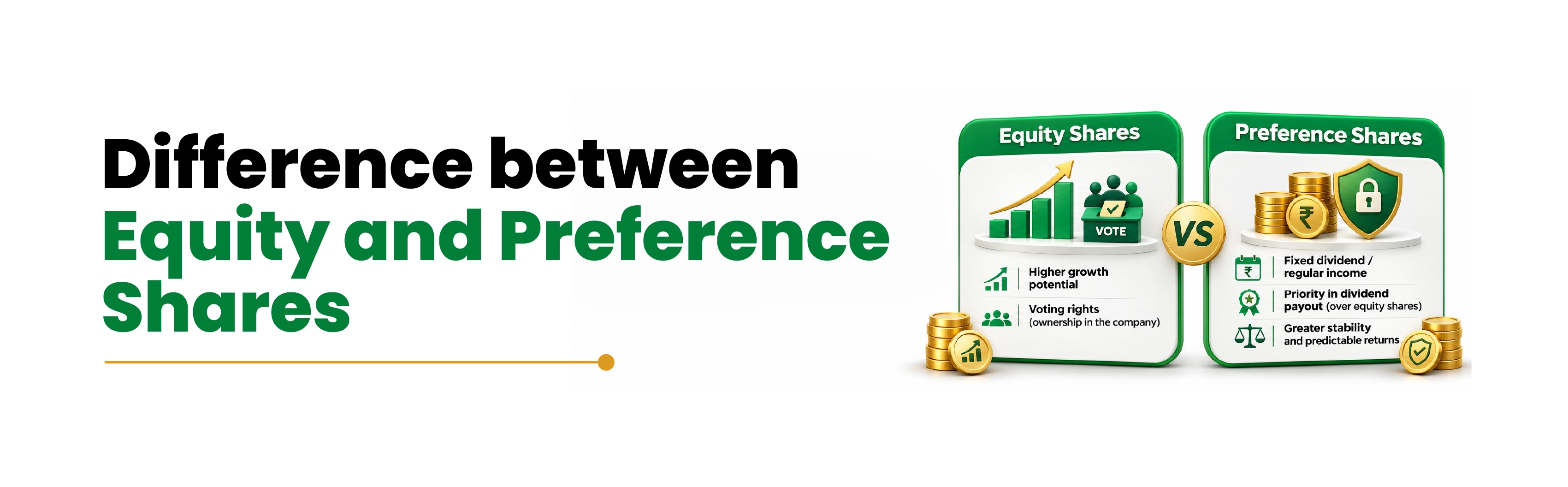
The difference between equity and preference shares comes down to the payment order and the vote. Equity shareholders own the company and share its growth, but they are paid last. Preference shareholders are paid ahead of them at a set rate, usually without a vote.
What Are Equity Shares?
Equity shares are the ordinary shares traded on NSE and BSE. Each one is a slice of ownership. Companies usually first sell them to the public through an initial public offering.
You can vote on every resolution (a formal shareholder decision). You may receive a dividend, but only if the board declares one, and only after preference holders are paid.
Bonus shares and rights issues normally go to equity shareholders. These are corporate actions, company decisions that change your holding. The catch: if the company is wound up (closed and its assets sold), you are last in line, after lenders and preference holders.
Also Read: If you are new to the stock market and want to understand how buying and selling shares works, explore our guide to Online Share Market Trading for Beginners.
What Are Preference Shares?
Under the Companies Act, 2013 (Section 43), preference shares carry two priority rights. You receive dividends at a fixed rate before equity holders, and your capital is repaid before theirs if the company closes.
Companies limited by shares cannot issue preference shares that are never redeemed (Section 55). They must redeem them, meaning buy them back, within 20 years, or up to 30 years for infrastructure projects.
A company may raise money through a mix of equity shares and preference share capital. Each issue sets its terms in pairs:
• Cumulative or non-cumulative: whether missed dividends carry forward
• Convertible or non-convertible: whether they can become equity shares
• Participating or non-participating: whether they share surplus profits
Preference shares are still share capital, unlike non-convertible debentures, which are loans.
Difference Between Equity Shares and Preference Shares
Basis | Equity shares | Preference shares |
What you own | Ownership stake | Priority claim on dividends and capital |
Dividend rate | Varies with profits | Fixed rate set at issue |
Dividend order | Paid after preference holders | Paid before equity holders |
Missed dividends | No catch-up | Carried forward if cumulative |
Voting rights | Every resolution | Matters affecting their rights; all matters after two unpaid years |
Repayment on closure | Last, from what remains | Before equity holders |
Redemption | None; you exit by selling | Within 20 years (30 for infrastructure) |
Conversion | Not applicable | Possible if issued as convertible |
Ease of selling | Varies by stock | Trading can be thin |
Tax on dividends | Your slab rate | Your slab rate |
How Equity Shares and Preference Shares Get Paid: A Worked Example
Take an illustrative company with ₹10 crore of equity (1 crore shares of ₹10) and ₹2 crore of 8% cumulative preference shares. Preference holders are owed ₹16 lakh a year, paid first.
Year | Board pays out | Preference holders | Equity holders |
1 | ₹66 lakh | ₹16 lakh | ₹50 lakh (₹0.50 a share) |
2 | Nothing | ₹0 (₹16 lakh owed) | ₹0 |
3 | ₹66 lakh | ₹32 lakh | ₹34 lakh (₹0.34 a share) |
In Year 3, the ₹16 lakh owed from Year 2 is paid first, so the same ₹66 lakh leaves equity holders with less. A non-cumulative holder would lose Year 2 entirely.
On closure, if ₹6 crore is left after creditors, preference holders take ₹2 crore and equity holders get ₹4 per ₹10 share. If only ₹1.5 crore remains, preference holders recover 75 paise per rupee, and equity holders get nothing.
Which One Fits Your Goals?
If you want a say in the company and a share of its growth, equity shares fit. The trade-off: dividends may stop, and prices can fall sharply.
Preference shares may suit a lower risk tolerance, where steadier income and an earlier payout matter more. But the dividend is paid only when declared, and income is usually capped at the fixed rate.
For both, check how easily you can sell. The Securities and Exchange Board of India (SEBI) lists limited or sporadic trading as a risk factor for public issues of non-convertible preference shares.
Since 1 April 2020, dividend income is taxed at your income tax slab rate, whichever share pays it.
Also Read: Before evaluating an equity investment, understand how companies generate earnings for each share through Earnings Per Share (EPS).
Conclusion
Neither share is better in every case. Equity shares reward risk with ownership and growth. Preference shares trade some of that upside for a place ahead in the payment queue.
Before buying any share, ask three questions. When do I get paid? Can I vote? How easily can I sell? If you are building a long-term equity portfolio, you can buy and hold shares for delivery through an Indiabulls Securities account. Whichever you choose, read the terms of issue first.