



If you own Reliance Industries shares, the Jio IPO will not drop free Jio shares into your demat account. That claim keeps circulating online. The draft prospectus does not support it.
What Reliance shareholders get instead is a separate bidding queue with its own ₹2 lakh limit. That is useful, but it is not free.
Jio Platforms filed its Draft Red Herring Prospectus (DRHP), the first version of an offer document, with SEBI on 19 June 2026. SEBI issued its observations on 28 August 2026. As of 5 October 2026, the price band, dates and lot size are still blank. Here is what the filing already settles.
All financial figures are from the DRHP dated 19 June 2026. The DRHP reports in ₹ million; figures here are converted to crore.
1. What is the Jio IPO, and how big will it be?
The issuer is Jio Platforms Limited, the holding company for Reliance Jio Infocomm (RJIL), which runs the mobile and broadband business. Reliance Industries (RIL) is the promoter and holds 66.43% before the issue.
The Jio IPO is a fresh issue of up to 27 crore shares of ₹10 face value. A fresh issue means new shares are created and the money goes to the company. There is no offer for sale, so no existing shareholder sells any shares. Meta, Google and the other 2020 investors keep everything they hold.
Jio has 893.90 crore shares today. Adding 27 crore takes the count to about 920.90 crore, so the issue is roughly 2.93% of the company after listing.
The rupee size depends on a price nobody has set yet. Two rules of thumb help. Every ₹100 on the issue price changes the amount raised by ₹2,700 crore. It also changes Jio's post-issue market value by about ₹92,090 crore.
2. Do RIL shareholders get free Jio shares?
No. They get a reservation, which is a slice of the issue set aside for them to bid in.
The DRHP defines Eligible RIL Shareholders as individuals and Hindu Undivided Families (HUFs) who hold RIL's public shares on the date the Red Herring Prospectus (RHP) is filed. The RHP is the near-final document that carries the price band. It has not been filed yet, so that eligibility date is not yet known.
Three rules from the DRHP matter most:
- You can bid up to ₹2 lakh in the RIL shareholder portion.
- You can also bid in the retail portion, and the two bids are not treated as duplicates.
- Like retail investors, you can bid at the cut-off price, which means accepting whatever final price is set.
So an eligible RIL shareholder could apply for up to ₹4 lakh across the two portions. How many shares the RIL portion will hold is still blank in the DRHP.
If the RIL portion is not fully taken up, the unused shares move to the employee portion first. Anything left after that goes to retail and non-institutional bidders in a 70:30 ratio.
3. How is the rest of the issue split?
After the employee and RIL reservations come out, the remainder is the net issue. The DRHP splits it the standard way for a large book-built issue:
| Category | Share of the net issue | Who it covers |
|---|---|---|
| Qualified institutional buyers | Not more than 50% | Mutual funds, insurers, banks, foreign funds |
| Non-institutional investors | Not less than 15% | Individuals bidding above ₹2 lakh |
| Retail individual investors | Not less than 35% | Individuals bidding up to ₹2 lakh |
Up to 60% of the institutional portion can go to anchor investors, who commit a day before the issue opens. Each retail bidder is promised at least one minimum lot, subject to shares being available.
Employees get their own reservation too. An eligible employee can bid up to ₹5 lakh, though initial allotment is capped at ₹2 lakh.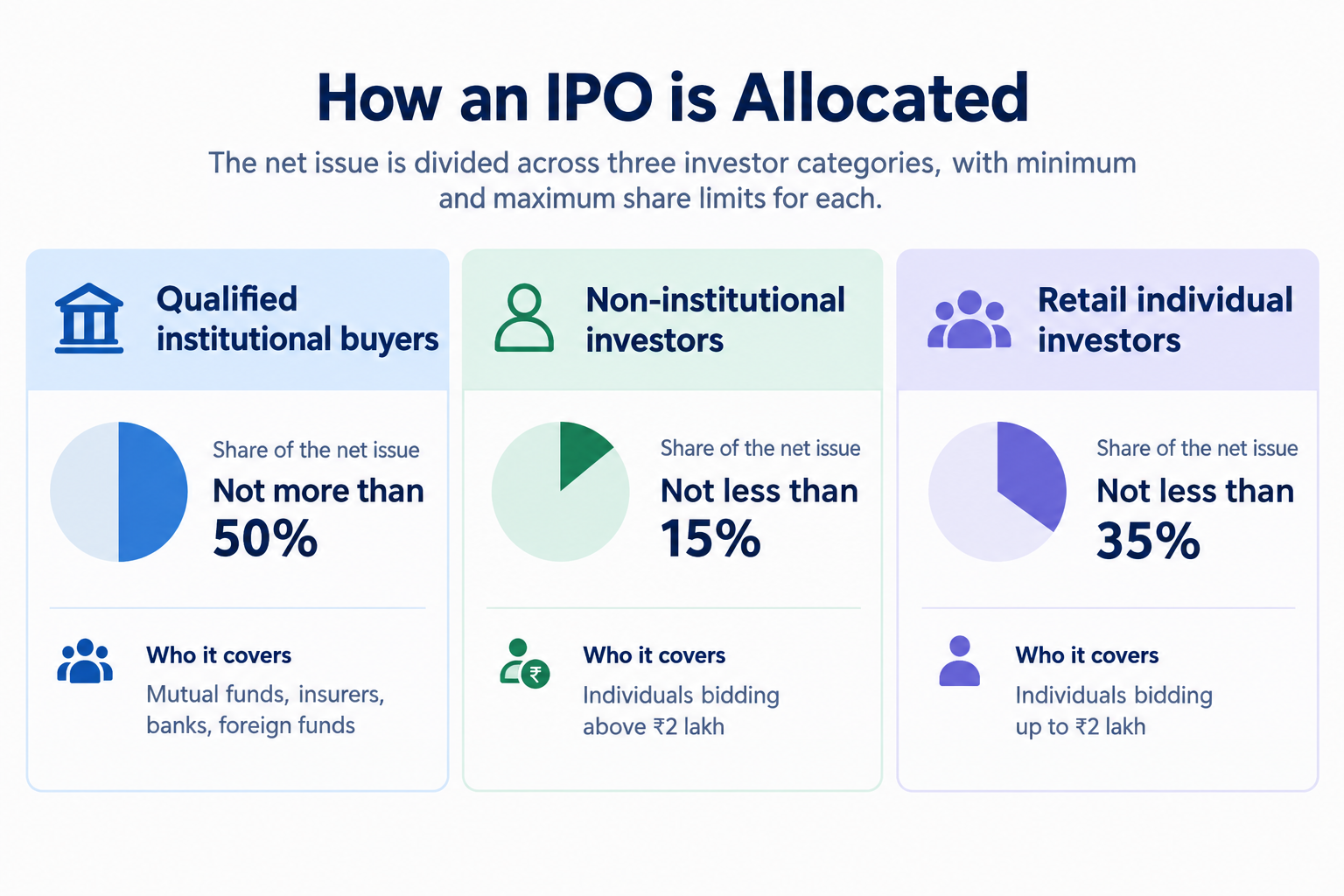
4. Where will the IPO money go?
Most of it repays debt. Up to ₹27,500 crore of the net proceeds is earmarked to prepay borrowings taken by RJIL, the operating subsidiary. The rest goes to general corporate purposes, which the DRHP caps at 25% of the gross proceeds.
The first loan on the prepayment list is an external commercial borrowing (ECB), a foreign currency loan from overseas lenders. It is a syndicated facility of US$676 million and JPY 44,923 million, together about ₹9,080 crore as on 31 March 2026.
Group borrowings stood at ₹70,781 crore on that date. The ₹27,500 crore prepayment would clear about 39% of it.
The DRHP also notes that the fund requirement has not been appraised by any bank or independent agency. That is common, but it means the plan rests on management estimates.
5. How much debt does Jio actually carry?
This is where the headline number needs a second look.
The DRHP reports net leverage of 0.36x for FY26, down from 0.88x in FY24. Net leverage is net debt divided by EBITDA, which is operating profit before interest, tax, depreciation and amortisation. On those numbers, debt looks like a small issue.
But the DRHP defines net debt as bank and market borrowings minus cash and current investments. It leaves out deferred payment liabilities. In Jio's case these are entirely instalments still owed to the government for spectrum bought in the 2021, 2022 and 2024 auctions.
| Item, 31 March 2026 | ₹ crore |
|---|---|
| Borrowings, current and non-current | 70,781 |
| Deferred payment liabilities | 1,04,514 |
| Lease liabilities | 13,888 |
| Cash and current investments | 43,202 |
The spectrum dues are about 1.5 times the size of all borrowings combined. Count them as debt and the leverage ratio moves from 0.36x to about 1.73x.
None of this is hidden. It sits on the balance sheet, just outside the ratio the DRHP leads with.
The dues are also long-dated and fairly cheap. About ₹77,700 crore falls due after five years, and the interest rate on the two largest tranches is 7.20% and 7.30%.
The debt now shows up in the profit statement too. Finance costs rose 76.42% in FY26 to ₹8,653 crore. Interest on 5G spectrum dues and related borrowings used to be added to the cost of the assets. Once those assets went into use, the DRHP says, that interest began hitting profit.
6. How profitable is Jio, and what changed in FY26?
Jio is large and profitable. The more important change is in how much cash is left after spending on the network.
| Fiscal year | Revenue (₹ crore) | Profit (₹ crore) | EBITDA less cash capex (₹ crore) |
|---|---|---|---|
| FY24 | 1,09,558 | 21,423 | 1,449 |
| FY25 | 1,28,218 | 26,109 | 19,902 |
| FY26 | 1,46,885 | 30,049 | 42,071 |
EBITDA less cash capex is operating profit minus the cash spent on towers, spectrum and equipment. In FY24 the two almost cancelled out. By FY26 the gap was ₹42,071 crore, because capex fell from ₹53,607 crore to ₹34,255 crore over the same two years.
The heaviest phase of the 5G rollout appears to be behind it. Jio had 524.4 million customers on 31 March 2026, including 268.5 million on 5G. Average revenue per user for the March 2026 quarter was ₹214 a month, up from ₹181.7 two years earlier.
The cost of that build-out has not vanished, though. It now sits in depreciation, finance costs and the spectrum dues covered above.
7. How does Jio compare with Airtel in its own peer table?
The DRHP's peer table names Bharti Airtel and Vodafone Idea. Vodafone Idea's figures are distorted by ₹58,607 crore of exceptional items, so the useful comparison is Airtel.
| FY26 measure | Jio Platforms | Bharti Airtel |
|---|---|---|
| Return on average net worth | 9.42% | 20.32% |
| Net asset value per share | ₹373.66 | ₹244.60 |
| P/E, NSE close on 17 June 2026 | Blank until pricing | 42.27 |
Return on net worth (RoNW) measures profit earned on shareholders' money. Jio's is less than half of Airtel's. Its return on capital employed has also slipped, from 12.83% in FY24 to 10.76% in FY26, as 5G assets entered the books.
The DRHP says Jio "shares characteristics with global technology platform companies." That framing argues for a higher multiple than a telecom operator usually gets. The 9.42% RoNW is the number it has to answer.
Once the band is out, you can do the maths yourself. FY26 earnings per share were ₹33.63. Spread across the larger post-issue share count, that is about ₹32.65.
8. What did Meta, Google and the 2020 investors pay?
The capital structure section lists every allotment. In 2020, Meta's affiliate Jaadhu Holdings and Google International paid ₹488.34 per share. Silver Lake, KKR, Vista, General Atlantic, Saudi Arabia's Public Investment Fund, Mubadala, ADIA, TPG, L Catterton, Intel and Qualcomm paid ₹549.31.
The face value is the same ₹10 today, and the DRHP records no split or bonus issue since. Meta now holds 9.98% and Google 7.73%.
Those prices bought a 2020 business that had not built 5G. They are not a guide to what the shares are worth now. They are, however, the clearest public benchmark of what sophisticated buyers once paid, and the issue price will invite that comparison.
9. What risks does the DRHP flag?
The DRHP lists 60 risk factors. Four stand out for a retail reader:
- The brand is not Jio's to control. RIL owns the "Jio" trademark and licenses it, and JioMart, AJIO, Jio Finance and JioHotstar use the same name.
- Key agreements run with RIL, Reliance Retail and other group entities, and some group companies compete or may compete with Jio.
- Jio paid no dividend in FY24, FY25 or FY26, and its loan agreements can restrict payouts.
- After the issue, RIL will still hold about 64.48%, enough to decide most shareholder votes.
Spectrum and licences are the other standing risk. They are granted by the government, and losing or failing to renew them would hit the core business directly.