

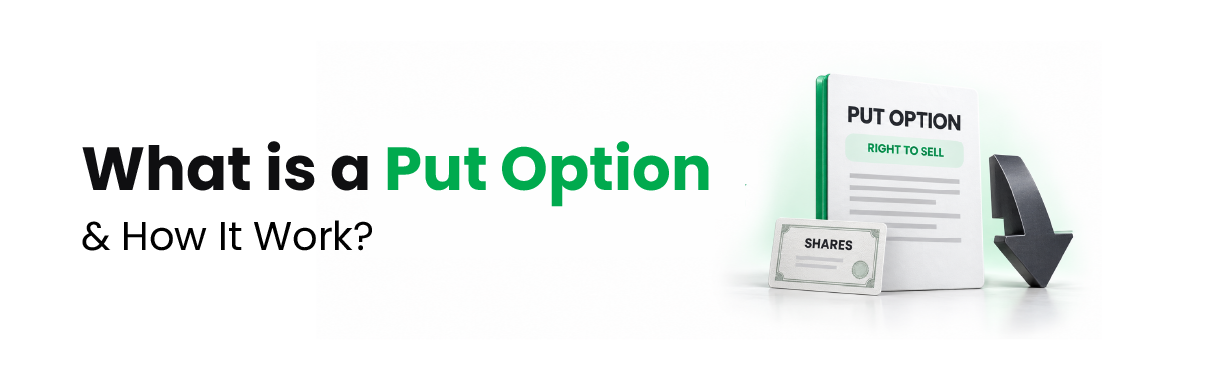
You own 500 shares of a stock and worry it could fall before the month ends. A put option gives you the right, but not the obligation, to sell a stock or other asset at a fixed price on a set expiry date.
You pay a premium for this right, and the seller takes on the duty to buy. That makes a put useful for hedging shares you hold, or for acting on a view that prices will fall.
Put Option Meaning
The buyer pays for a right and is called long. The seller, or option writer, collects that payment, accepts an obligation and is called short.
A practical put option definition rests on four terms:
• The strike price is the fixed price at which the buyer can sell.
• The premium is the price of the put, paid by the buyer to the seller.
• Expiry is the contract's last day, which for NSE stock options is the last Tuesday of the month.
• A lot is the fixed quantity in one contract. NSE sets each stock's lot size so a contract is worth at least ₹5 lakh when introduced.
On trading screens, puts carry the label PE, NSE's code for Put European.
How a Put Option Works: One Contract, Both Sides
Take an illustrative stock at ₹1,000 with a lot of 500 shares, so one contract is worth ₹5 lakh. You buy the 980 PE, a put with a ₹980 strike, at a premium of ₹20. Your cost is ₹10,000 (₹20 × 500), which brokers must collect upfront under SEBI rules effective 1 February 2025.
Your breakeven is strike minus premium: ₹960. The seller receives your ₹10,000 and takes the opposite side.
Stock price at expiry | Buyer's result | Seller's result |
₹1,050 | Loss of ₹10,000 | Gain of ₹10,000 |
₹980 | Loss of ₹10,000 | Gain of ₹10,000 |
₹960 | Nil | Nil |
₹900 | Gain of ₹30,000 | Loss of ₹30,000 |
₹800 | Gain of ₹80,000 | Loss of ₹80,000 |
Figures exclude brokerage and taxes.
The buyer's loss stops at ₹10,000, however high the stock climbs. The seller's gain stops at ₹10,000, while the loss grows with every rupee of fall.
Before expiry, the premium moves with the stock price, time left, interest rates and how sharply the stock is expected to swing. As expiry nears, a put loses value even if nothing else changes. That is time decay, and it hurts the buyer daily.
Also Read: To understand how strike selection affects your premium, breakeven, and potential payoff, explore How to Choose the Right Strike Price in Options Trading.
What Is Put Option in Stock Market Trading Used For?
Traders use puts in three ways, each with a different risk.
1. Protecting shares you own: if you hold 500 shares and buy the 980 PE at ₹20, your worst-case selling price at expiry is ₹960. This is a protective put. If the stock stays above ₹980, the ₹10,000 is the cost of cover.
2. Betting on a fall: buying a put without owning the shares is a long put. It gains if the price drops below breakeven, and the most you can lose is the premium.
3. Collecting premium: selling a put is a short put. You keep the premium if the stock stays above the strike. A fall to ₹800, though, costs the seller ₹80,000 against ₹10,000 collected.
Put Option vs Call Option
A put and a call are mirror images. When you compare call and put options side by side, these are the differences that matter:
Feature | Put option | Call option |
Buyer's right | To sell at the strike price | To buy at the strike price |
Buyer's view | Price will fall | Price will rise |
Buyer gains when price is | Below strike minus premium | Above strike plus premium |
Buyer's maximum loss | Premium paid | Premium paid |
Seller's obligation | To buy if exercised | To sell if exercised |
For a given stock and expiry, NSE uses the same lot size for puts and calls.
Also Read: For a more detailed comparison of their features, risks, and uses, read our guide to Call and Put Options: Key Differences
What Happens to a Put Option at Expiry in India
NSE stock options are European style, exercisable only at expiry, and physically settled. Index options settle in cash.
Physical settlement means real shares change hands. If the stock closes at ₹900 on expiry and you still hold the 980 PE:
• You must deliver 500 shares, buying them first if needed, and receive ₹4,90,000.
• The seller must pay ₹4,90,000 for shares worth ₹4,50,000.
You also pay Securities Transaction Tax (STT) of 0.15% on the intrinsic value, which is strike minus settlement price. Here that is ₹60 on ₹40,000, at rates from 1 April 2026. A put expiring at or above its strike lapses.
To avoid delivery, sell the put before expiry. STT is then 0.15% of the premium. At Indiabulls Securities, brokerage is 2.5% or ₹11 per executed order, whichever is lower, across NSE (CM, FO, CD), BSE (CM, FO) and MCX.
When a Put Option Goes Wrong
A put usually fails in four ways:
• The fall arrives after expiry. By then, time decay has eaten the premium.
• The fall is too small. A drop from ₹1,000 to ₹970 still loses ₹5,000, because breakeven is ₹960.
• A seller underestimates the downside. Losses grow with every rupee of fall, so check the margin on a margin calculator first.
• The premium costs too much. A bear put spread reduces it by also selling a lower-strike put, but caps your gain.
SEBI's FY26 study found that 87.7% of individual equity derivatives traders made net losses that year, totalling ₹91,685 crore. Read up on common options trading mistakes before your first trade.
Conclusion
Before trading a put, answer three questions. Do you own the shares, or are you betting on a fall? How far must the price drop to clear your breakeven? Can you meet delivery, or will you exit before expiry?
Then look up PE contracts on the Option Chain to compare live premiums across strikes and expiries. The derivative trading page explains how futures and options (F&O) work at Indiabulls Securities. Size each position so its worst case is a loss you can absorb.
Learn more about F&O Trading and the basics of the futures and options market before deciding whether derivatives suit your risk tolerance.