

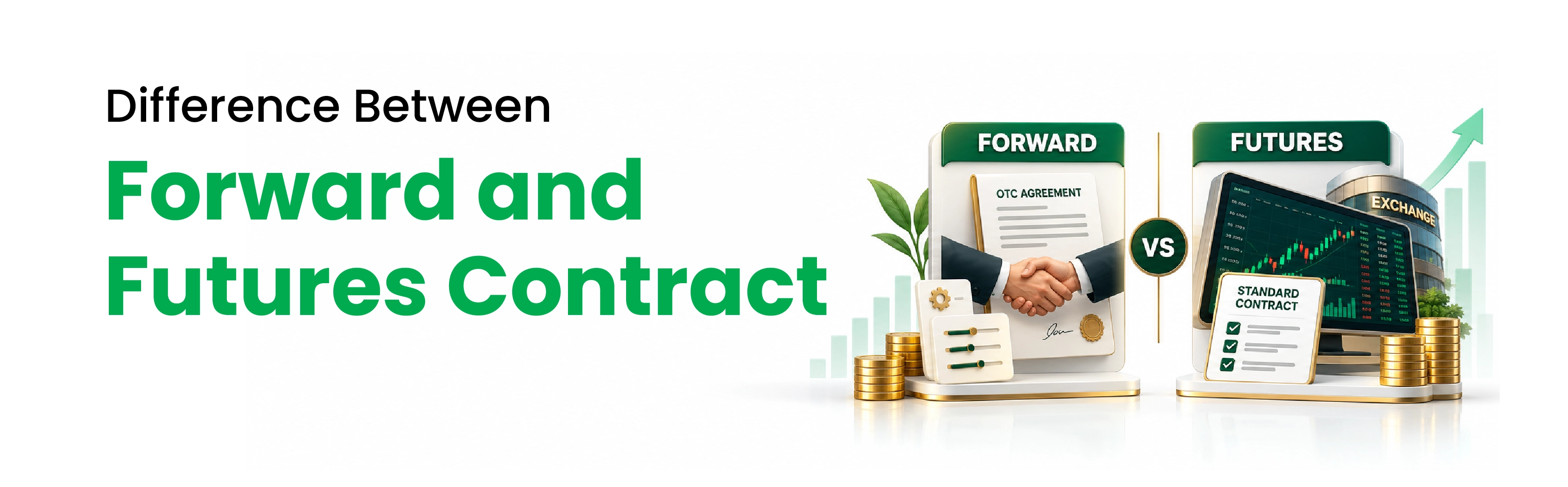
Two people agree today to trade a listed share three months from now, at a price they fix themselves. Nothing is filed. No exchange knows. No margin is called that evening, or any evening after it.
In India that agreement does not pass the test Section 18A sets for a derivative contract, and the difference between forward and futures contract starts there.
What Is a Forward Contract?
A forward contract is a private agreement between two parties to buy or sell an asset on a future date at a price fixed today. The quantity, date and price are negotiated.
An Indian resident meets a forward through a bank. Authorised Dealer Category-I banks offer foreign exchange forwards for hedging, retail users included, and the Reserve Bank requires that the contract's size and tenor not exceed the exposure being hedged.
Below 100 million dollars of notional value, the contract's face value, that exposure need not be evidenced upfront.
What Is a Futures Contract?
A futures contract is the same promise, standardised and moved onto an exchange. The exchange fixes what the two of you cannot: the underlying, size, expiry and price step.
Nifty 50 futures run on a three-month cycle, and each expires on the last Tuesday of its month, or the previous trading day if that is a holiday. No contract may be introduced below ₹15 lakh.
Once the trade is done, the clearing corporation steps between the two sides. Its bye-laws call this novation: interposing itself between both parties of every trade, being the legal counterparty to both.
Difference Between Forward and Futures Contract
Section 18A of the Securities Contracts (Regulation) Act, 1956 sets the test. A contract in derivative is legal and valid if it is traded on a recognised stock exchange and settled on that exchange's clearing house.
The section also allows terms the Central Government notifies, which no retail investor can use.
Forward | Futures | |
Where it trades | Privately | On a recognised exchange |
Terms | Negotiated | Standardised |
Who guarantees it | Nobody | The clearing corporation |
Indian securities law | Fails the Section 18A test | Meets it |
When money moves | Once, at maturity | Upfront, then every evening |
Exit early | Only by agreement | Sell in the market |
Typical user | A business hedging | Hedgers and traders |
Also Read: To understand where futures fit within the broader derivatives segment, explore What Are Futures and Options (F&O).
Forward Contract vs Futures Contract: Key Differences
Who stands behind the trade. NSE Clearing holds a Core Settlement Guarantee Fund of over ₹12,000 crore. A forward has no equivalent, and is only as good as the counterparty.
When money moves. Futures margin, the deposit taken before you may hold the position, is collected upfront at 99% value at risk. An extreme loss margin sits on top: 2% of contract value on index derivatives, 3.5% on stock.
A forward takes nothing until maturity, which costs less but hides the loss until it arrives whole.
How it ends. SEBI made physical settlement mandatory for all stock derivatives from the October 2019 expiry. A single stock future held past expiry settles by delivery on T+2. Index futures such as Nifty settle in cash.
Also Read: Futures involve margin and daily settlement, so understanding the broader mechanics of futures can help before considering how these contracts are used. Read What Are Futures in the Stock Market.
Forward vs Futures Contract: An Example
An importer owes 2,00,000 dollars in three months and books a forward with their bank at a rate fixed today. Nothing moves on the day they sign, or for three months after.
A trader instead holds a Nifty 50 futures position worth ₹18 lakh. Before it opens, the extreme loss margin alone takes 2% of that, ₹36,000. Every evening after, the day's gain or loss is settled in cash.
One sits still for three months, while the other bills you every night.
Advantages and Risks of Forward and Futures Contracts
A forward's advantage is fit: it matches the exact amount and date of the exposure, and demands no money upfront. Its risk is the other side: no clearing corporation, no daily settlement to reveal a loss, no exit without consent.
A futures contract is guaranteed and liquid, and you can leave any trading day by selling what you bought.
Against that, margin locks up money before you earn anything, and daily settlement can force you out of a position you still believe in. A stock future carried past expiry becomes a delivery obligation for the full contract value, not a cash difference.
Which Is Better Between Forward and Futures Contracts?
For a listed Indian share this is not a preference. Section 18A leaves the exchange-traded, clearing-house-settled futures contract as the route open to you.
Where both exist, a business exposure on an odd amount and date favours the forward through your bank. Taking a market position favours futures, where settlement is guaranteed and exit needs no permission.
Neither removes the loss if the price moves against you.
Conclusion
The table above is true, but it is not the first question. The first question is which contract the law will recognise.
Once you are inside the exchange-traded segment, the rest is published before you trade. Contract specifications, margin and expiry dates are set by the exchange, and Option Chain Analysis covers the options half of the same segment.
All of it sits on the Indiabulls Securities F&O Trading Online platform. None of it removes the risk of loss on the position.