

A straddle strategy is usually described as a bet on volatility. That is only half right. Buying a call and a put at the same strike and expiry is a bet that the market has underestimated the coming move. The combined premium is the market's own forecast of it. Beat it and the trade pays. Fall short and you lose, even when the move arrives.
What Is a Straddle Option Strategy?
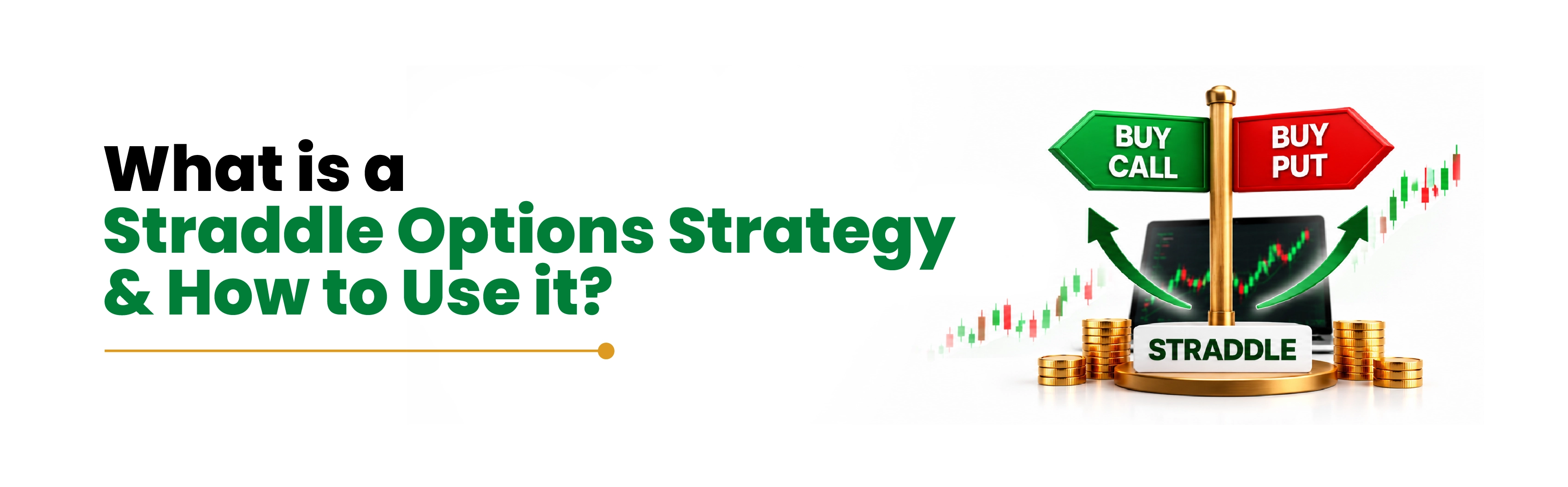
A straddle pairs a call and a put on the same underlying, strike price and expiry. The strike price is where an option can be exercised; the premium is what you pay to buy it, or receive to sell it.
Traders usually pick the at the money (ATM) strike, closest to the current price. The straddle meaning in stock market terms is a position sitting astride the price, waiting for a sharp move.
Buying both legs creates a long straddle, which needs a large move; selling both creates a short straddle, which needs calm. New to the basics? Start with call and put options.
Also Read: Before selecting the call and put legs, understand How to Choose the Right Strike Price in Options Trading and how strike selection affects your trade.
How a Straddle Strategy Works: A Worked Example in Rupees
Illustrative figures: Nifty 50 at 25,000 before an RBI policy announcement. You buy the weekly 25,000 call at ₹180 and the 25,000 put at ₹170, a combined premium of ₹350.
One Nifty lot covers 65 units (since January 2026), so a lot costs ₹22,750, your maximum loss. Your breakevens are 24,650 and 25,350, so the market is pricing in a move of about 1.4%. You profit only beyond it.
Nifty at expiry | Result per lot |
25,600 (call worth ₹600) | Profit of ₹16,250 |
25,200 (call worth ₹200) | Loss of ₹9,750 |
25,000 | Loss of ₹22,750 |
24,400 (put worth ₹600) | Profit of ₹16,250 |
Costs widen both breakevens. Indiabulls Securities charges 2.5% or ₹11 per executed order, whichever is lower, across NSE (CM, FO, CD), BSE (CM, FO) and MCX. Four orders cost at most ₹44 plus GST. Securities Transaction Tax (STT) of 0.15% on sold premium (as of April 2026) adds ₹58.50 on a ₹600 call exit. The brokerage calculator adds exchange charges and stamp duty.
Also Read: Understanding Risks of Options Trading can help you evaluate potential losses, breakeven levels, and the risks involved before entering a position.
Long Straddle vs Short Straddle
One pays you for movement, the other for calm. Time decay, the daily erosion of an option's value, hurts buyers and helps sellers. Margin is the deposit a broker blocks against a short position.
Long straddle | Short straddle | |
Your view | Big move, direction unknown | Price stays near the strike |
Legs | Buy ATM call and ATM put | Sell ATM call and ATM put |
Maximum profit | Unlimited on the upside, large on the downside | Combined premium received |
Maximum loss | Combined premium paid | Unlimited |
Capital needed | Premium only | Margin on both legs |
The long straddle guide covers entry and exits. Read the short straddle guide before selling.
When Does a Straddle Option Make Sense?
A straddle suits a scheduled event with an uncertain outcome, such as an RBI policy decision or quarterly results. The real question is whether the move will beat what the premium implies.
Compare that implied move with how far the stock or index usually moves on similar days. Then check whether premiums look inflated; option chain analysis lets you compare them strike by strike. India VIX, NSE's measure of expected Nifty volatility over the next 30 days, gives a market-wide read.
If the straddle looks expensive, a long strangle, with its call above and its put below the price, costs less but needs a bigger move.
Going Deeper: When a Straddle Strategy Goes Wrong
Three failures catch traders out.
Volatility crush: implied volatility (IV) is the size of price swings built into option premiums. It swells before a known event and often collapses after it. That IV crush hits both legs, so a long straddle can lose even after a real move.
Weekly decay: every quiet day shaves value off both legs, and a weekly contract leaves little time for the move.
Unlimited loss for sellers: a sharp move can cost a short straddle far more than its premium. Since November 2024, SEBI also levies a 2% Extreme Loss Margin (ELM) on short index options on expiry day, so check the margin calculator before selling.
Before You Place a Straddle: A Quick Checklist
Run five checks first:
• Note the move the premium implies.
• Compare it with the usual move on similar events.
• Check whether premiums look inflated against their normal level.
• Run both legs through the Greeks calculator for decay and volatility exposure.
• Fix your exit and size the trade so losing the premium is affordable.
A straddle pays only when you are more right than the market. If the premium prices in 1.4% and similar events have moved Nifty 1%, the arithmetic has already answered.